
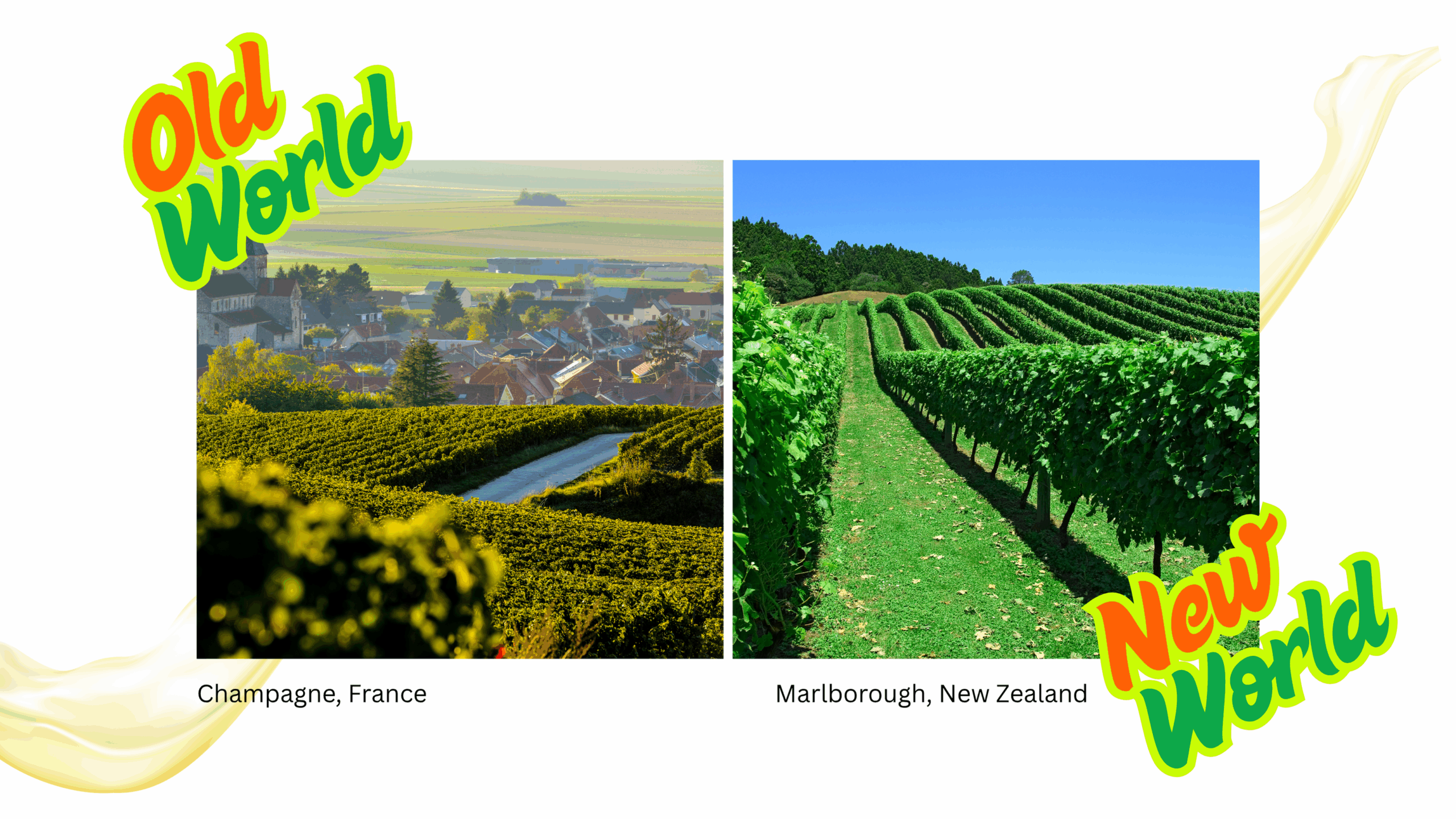
What Do These Terms Mean?
Old World wines originate from regions in Europe (and parts of the Mediterranean and Near East) with centuries—or millennia—of grape-growing history. This includes countries like France, Italy, Spain, Portugal, Germany, Greece, Austria, Hungary, and even historic producers in North Africa and the Eastern Mediterranean
New World wines are crafted outside these traditional areas. Major New World regions include the U.S. (especially California), Canada, Australia, New Zealand, Argentina, Chile, South Africa, Mexico, Brazil, and Japan.
Core Differences at a Glance
| Feature | Old World | New World |
|---|---|---|
| Approach | Terroir-focused, reflecting site-specific geography, soil, climate and tradition | Winemaker-focused, highlighting varietal expression and modern techniques |
| Labeling & Laws | Strict rules (e.g., AOC, DOC), labels based on region/place of origin | Looser or no regional regulation; labels mostly by grape variety; branding emphasized |
| Wine Style | Lower alcohol, higher acidity, mineral and savory profiles; “earth-driven” | Riper, fruit-forward, fuller-bodied, often richer and oak-influenced |
| Viticulture & Winemaking | Dense vineyards, manual labor, wild yeast, slow evolution | Wider spacing, mechanical harvesting, cultured yeast, scientific interventions like temperature control and enzymes |
| History | Ancient traditions dating back to Phoenicians, Romans, Greeks (e.g., Georgia’s 8,000-year winemaking) | Began late 15th–16th centuries with European settlers; rapid modernization after 1970s |
Old World Regions: A Closer Look
Old World wine regions include:
-
France (Bordeaux, Burgundy, Champagne, Rhône, Loire…)
-
Italy (Tuscany, Piedmont, Veneto, etc.)
-
Spain & Portugal (Rioja, Douro, Alentejo…)
-
Germany, Austria, Greece, Hungary, Romania
-
North Africa & Eastern Mediterranean (Lebanon, Israel, Cyprus, Georgia…)
Here, wine laws are deeply rooted in history. For example, in Bordeaux and Burgundy, the AOC system governs grape variety, vineyard plot, vine density, yields, winemaking techniques, sugar levels—and ensures a sense of region in every bottle .
New World Regions: Innovation and Expression
New World wine regions include:
-
U.S. (California, Oregon, Washington)
-
Canada, Australia, New Zealand
-
Argentina, Chile, South Africa, Mexico, Brazil, Japan
Here, winemaking freedom reigns: producers choose grapes first—the terroir and branding follow. Labels showcase grape types (e.g. Shiraz, Cabernet Sauvignon), and technology plays a big role. Mechanical harvesting, stainless steel tanks, oak utilization, and modern yeast are standard .
How These Differences Shape the Wine
-
Terroir vs Fruit: Old World wines express their origin—minerality, earthiness, and lower alcohol. New World wines highlight varietal fruit character, often with higher alcohol and oak aging.
-
Label Clues: An Old World wine calls itself “Chianti” or “Rioja” (region). A New World wine says “Malbec” or “Chardonnay” (grape).
-
Winemaking Tools: In the Old World, tradition rules. In the New World, science transforms—temperature control, new oak, and consistency-focused blending are hallmarks.
-
Legislation: Old World regions follow a hierarchy of rules. In the New World, mandatory AVAs or regions (e.g. AVA in U.S.) exist, but with flexibility in grape sourcing and practices.
Are These Terms Still Useful?
Critics note the Old vs New framework is oversimplified in today’s global scene. Climate change, cross-regional influences, and winemaker mobility (e.g., “flying winemakers”) blur boundaries . Even in Europe, modern tools like jacketed tanks and new grape varieties are becoming common. What’s now more relevant is style and production philosophy—whether wines are industrial or agricultural in ethos—rather than geography alone.
Why It Still Matters—and What to Say at the Table
-
Entry point for education: These terms help beginners grasp the broad concepts of style, labeling, and origins.
-
Style shorthand: If you crave mineral, food-friendly wines for dinner, lean Old World. Want ripe, bold, fruit-driven wine for glass-in-hand enjoyment? Go New World.
-
Doing deeper dives: Once you’re beyond the basics, explore wines by region, producer philosophies, and vineyard practices.
The Old World vs New World divide offers a helpful lens—not a rulebook. While geography set the stage, today’s wine world is a dynamic fusion of tradition and innovation. Encourage readers to start with this framework, then dive deeper: taste across regions, compare labels, explore winemaking techniques, and decide what speaks to them.