
 First Things First: What are Sulfites?
“Sulfites” in wine refer primarily to sulfur dioxide (SO₂), a compound that both occurs naturally during fermentation and is often added intentionally by winemakers. Yeast produces small amounts of SO₂ as a natural by-product, which is why all wines contain at least trace sulfites—even when none are added.
Chemically, SO₂ is a multitasker:
-
- Antioxidant: Binds with oxidizing compounds (e.g., acetaldehyde), slowing browning and staling.
- Antimicrobial: Suppresses spoilage yeasts and bacteria that generate off-flavors, haze, or re-fermentation.
Because of these protective roles, most wines receive some added SO₂, usually at harvest (to protect the must), around racking, and/or at bottling.
How much SO₂ is in wine? (And how that compares to food)
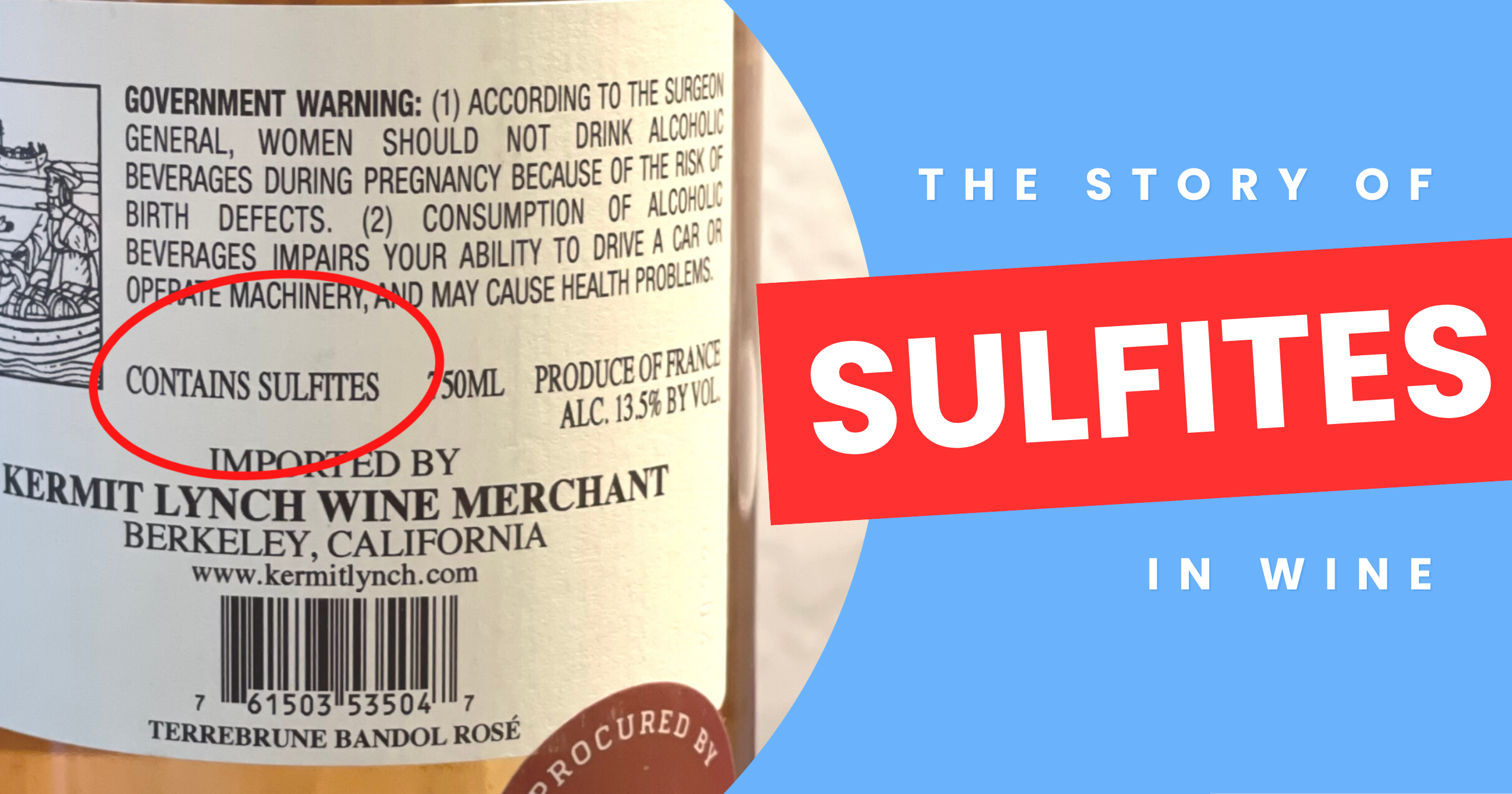
In the U.S., wines must state “Contains Sulfites” on the label if total SO₂ is ≥10 mg/L (ppm); the legal maximum is 350 mg/L. Typical table wines are much lower—often on the order of ~80 mg/L on average, with whites generally higher than reds.
❗️For perspective, bright orange dried apricots commonly contain ~2,000 mg/kg (ppm) sulfites—a great deal more than a glass of wine.
The EU and OIV set category-specific limits that are lower than the U.S. blanket cap and vary by wine style (e.g., ~150 mg/L red, 200 mg/L white/rosé, with higher allowances for sweet wines).
🍷Why reds often need less SO₂ than whites
Red wines spend time on skins, extracting tannins and phenolics that have their own antioxidant capacity, so they typically require less protective SO₂ than delicate, more oxygen-susceptible whites and rosés. (This is a tendency, not a law of nature; style, pH, sugar, and winery hygiene also matter.)
“Natural,” Minimal-Intervention, Organic, and Biodynamic: Where do Sulfites Fit?
Natural / Minimal-Intervention
There’s no single legal definition of “natural wine.” In practice, the term signals native fermentations, low cellar manipulation, and little or no added SO₂ (sometimes none until bottling, and often at very low levels compared with conventional norms). Some voluntary frameworks cap additions tightly—for example, Vin Méthode Nature allows no additions before/during fermentation and ≤30 mg/L at bottling; RAW WINE fairs publish SO₂ totals and accept only well below EU limits.
“Minimal-intervention” is a broader philosophy rather than a certification; producers may still add SO₂ “just enough” to protect wine character and stability.
Organic (U.S. vs. EU)
- United States (USDA): To bear the “organic wine” claim, no added sulfites are permitted (naturally occurring sulfites must remain <10 mg/L). Wines “made with organic grapes” may add sulfites but remain below 100 mg/L total. Labeling hinges on these thresholds.
- European Union (EU organic): Added sulfites are allowed but at reduced maxima vs. conventional wine (e.g., 100 mg/L red, 150 mg/L white/rosé).
Biodynamic (Demeter)
Biodynamic certification focuses on farm ecology and specific preparations, but it does allow added SO₂ within tighter bounds than conventional practice—typically up to ~100 mg/L for dry wines (some national Demeter standards allow up to 150 mg/L for dessert wines).
What SO₂ actually protects against (and what it doesn’t)
- Oxidation: SO₂ reacts with oxidative intermediates, slowing browning, loss of aromatics, and the development of stale/sherry-like notes in susceptible wines.
- Microbial spoilage: By suppressing organisms like Brettanomyces, Lactobacillus/Pediococcus, or film yeasts, SO₂ reduces off-flavors (e.g., volatile phenols) and prevents turbidity from uncontrolled growth.
In other words, SO₂ is quality insurance: too little can mean premature oxidation or microbial faults; too much can be sensorily harsh. Skilled winemaking aims for the lowest effective dose.
“We’re not adding a bunch of weird shit to our wine, but we use sulfites if I think it will make the wine better. We’re trying to make wine we’re proud of.”
— Steve Matthiasson, co-founder of Matthiasson Wines
Health, Sensitivity, and Labeling
A small subset of individuals—particularly some asthmatics—can react adversely to sulfites; hence the 10 mg/L labeling threshold to inform consumers. However, the medical literature does not support the notion that sulfites cause headaches broadly; wine headaches are more often associated with alcohol, histamine/biogenic amines, or other factors. If sulfites were the culprit, dried fruit would be the usual suspect long before wine.
Quick Reference: How Categories Line Up on Sulfites
-
- Conventional (U.S.): up to 350 mg/L; label required ≥10 mg/L.
- OIV/EU conventional guidance: typical maxima ~150 mg/L red; 200 mg/L white/rosé; higher allowances for sweet wines.
- U.S. “Organic wine”: no added sulfites; naturally occurring must be <10 mg/L.
- U.S. “Made with organic grapes”: added SO₂ permitted; ≤100 mg/L total.
- EU Organic wine: added SO₂ allowed at reduced maxima vs. conventional (e.g., 100/150 mg/L red/white).
- Biodynamic (Demeter): allowed within stricter caps (commonly ≤100 mg/L for dry wines; ≤150 mg/L for dessert).
- Natural / Minimal-intervention: no legal definition; many producers add none or very little, with some charters allowing ≤30–70 mg/L and forbidding additions before/during fermentation.
The Bottom Line (and why this topic gets confusing)
- Every wine has a level sulfites because a little is always produced as a byproduct of fermentation. And added SO₂ is about protecting wine quality—not “hiding flaws.”
- Wine is a relatively small dietary source of sulfites compared to many everyday foods—especially some preserved or anti-browning items like dried fruits.
- Terms like “natural” and “minimal-intervention” are philosophies, not laws; organic and biodynamic have codified standards, and those standards do differ between the U.S. and EU, particularly around added SO₂.
💡If you want to drink lower-SO₂ wines, look for:
-
- U.S. labels reading “Organic Wine” (no added SO₂), or “Made with Organic Grapes” (≤100 mg/L).
- EU organic bottlings (reduced maxima).
- Biodynamic (Demeter) wines (tight caps).
- Producers who publish SO₂ numbers or who align with Vin Méthode Nature / RAW WINE charters.
“It’s nails on a chalkboard to me. People misunderstand what sulfites really are. It’s an organic compound, a natural chemical, that forms naturally during fermentation. All wines have sulfites.”
— Erik Segelbaum, wine consultant at Somlyay
Sulfites: Friend, Foe, or Tool?
At the end of the day, sulfites aren’t the villains they’re often made out to be—they’re simply a tool, one that winemakers have used for centuries to keep wine fresh, stable, and true to its character. Whether you gravitate toward natural, biodynamic, organic, or conventionally made wines, every bottle tells a story shaped by choices in the vineyard and cellar—not by a single ingredient. So, next time you raise a glass, savor what’s in it, not what’s been unfairly blamed for your wine headache. After all, understanding sulfites just makes that sip a little sweeter—and a lot more interesting.